
Somewhere in every business’s expense report sits a line item nobody has ever reviewed: bin liners. They get bought the way they’ve always been buying the same product, same source, reordered by habit, while costing more than anyone assumes. A busy hospitality venue or multi-site cleaning operation goes through thousands of liners a year; even a modest office consumes a steady stream. At those volumes, buying the wrong spec from the wrong channel quietly wastes hundreds to thousands of dollars annually.
This guide is the review that line item never gets. It covers how commercial liners are actually specified, which channel to buy from, how to calculate what you really use, and how to turn the whole category into a set-and-forget system. For any operation comparing options for a bin liner perth businesses constantly reorder, the decisions below are the whole game.
Step 1: Audit What You Actually Use
Before buying anything, spend twenty minutes counting. Walk the premises and record:
- Every bin, with its litre capacity(printed on most commercial bins) — pedal bins, kitchen bins, wheelies, external bins
- What goes in each— paper, mixed general waste, wet food waste, sharp or heavy waste
- How often each is emptied— per day or per week
That’s your consumption map. Most businesses discover two things immediately: they’re using more liners than anyone guessed, and they’re running one liner spec across bins that need different ones — usually a mid-grade bag that’s overkill for the office bins and underspecified for the kitchen or workshop.
Step 2: Specify Properly (and Stop Overpaying Both Ways)
Liner specification has three levers size, strength and material and getting them right cuts cost in both directions: no premium film where light waste goes, no failures where heavy waste goes.
The Short Version of Spec
- Size to the bin’s litre rating. Undersized liners tear at the rim; oversized ones waste film. 27–36L for pedal bins, 54–82L for general commercial bins, 120–240L for wheelies.
- Strength to the worst regular waste. Light duty for paper and bathrooms; medium for mixed general waste; heavy duty for wet kitchen loads, workshop waste and full wheelie bins.
- Material to the risk. Stretchy LDPE film resists punctures around sharp or irregular waste; stiffer HDPE is economical for light, soft waste.
Most businesses land on a standard kit of just two or three specs — for example, a light office liner, a medium general-waste liner, and a heavy kitchen/wheelie liner. Standardising that kit is what unlocks the next step. When comparing commercial bin liners Perth suppliers offer, quote that standard kit as a package rather than pricing items individually — volume across a consolidated list is where trade pricing does its work.
Two Failure Signs Worth Fixing Now
- Double-bagging anywhere means the spec is one grade too light — a single correct liner is cheaper than two wrong ones.
- Liners knotted at half-full because staff don’t trust them means the same thing, plus wasted capacity on every change.
Step 3: Choose the Channel — Retail, Marketplace or Trade
Where you buy matters as much as what you buy, because liner margins vary wildly by channel.
Retail (supermarkets, hardware) is the most expensive per liner by a wide margin and involves someone physically shopping. Defensible only for emergencies.
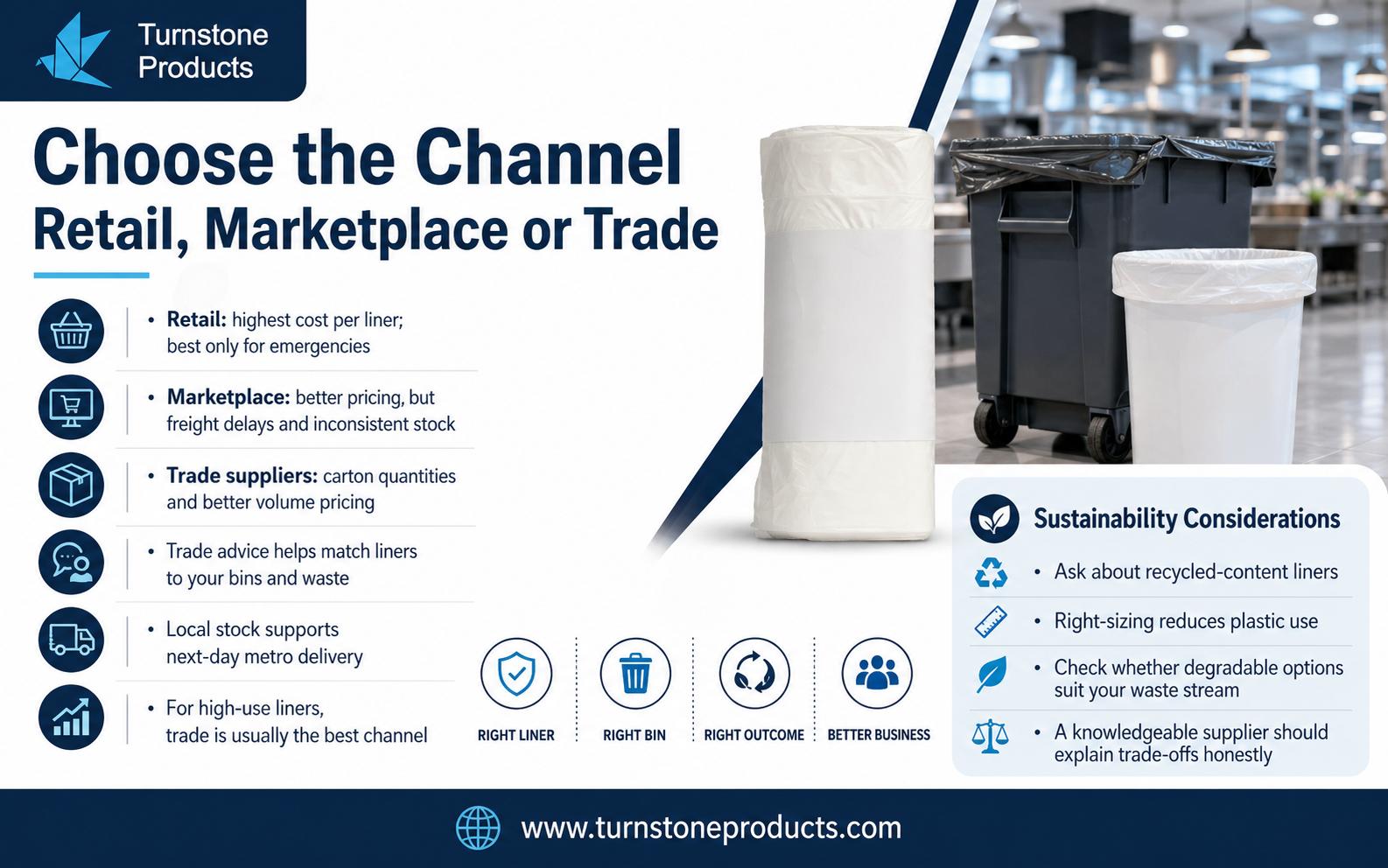
Online marketplaces improve unit pricing but bring freight delays from interstate stock, inconsistent product continuity, and zero advice. Nobody at a marketplace will tell you your kitchen bags keep failing because they’re HDPE.
Local trade suppliers are built for this category: carton quantities, quote-based pricing that improves with volume, product advice matched to your bins and waste, and local stock with next-day metro delivery. For consumption-heavy items like liners, trade is the correct channel almost regardless of business size; the carton-versus-retail price gap per liner is among the widest in all consumables.
Sustainability Considerations
Many Perth businesses now weigh environmental factors alongside price. Worth asking any supplier about: liners with recycled content, correctly sized bags (right-sizing is itself a plastic reduction), and whether degradable options suit your waste stream. A knowledgeable supplier can walk through the trade-offs honestly rather than green-labelling everything.
Step 4: Systematise the Reorder
With specs standardised and a trade supplier chosen, close the loop:
- Calculate monthly consumption from your audit bins × changes per week × 4.3.
- Order in cartons to that consumption, with a small buffer next-day local delivery means the buffer can stay lean.
- Put it on the standing order with your other consumables — one delivery, one invoice.
- Assign an owner— when the last carton of any spec is opened, it goes on the next order.
- Re-audit annually— bins change, menus change, headcounts change; the kit should track it.
From this point the category runs itself, at trade pricing, with no stockouts and no thought required — which is precisely what a business should want from bin liners.
Why Choose Turnstone Products
Turnstone Products is a Perth-based B2B supplier that treats bin liners the way this guide does — as a specified product, not a commodity guess. The range covers office, kitchen, general-waste and heavy-duty wheelie-bin liners in commercial sizes, sold by the carton at wholesale pricing that improves with volume. Because ordering runs by quote form or phone, you can hand over your bin audit and get the right two-or-three-spec kit recommended and priced as a package — and liners ship on the same next-day Perth metro delivery as Turnstone’s cleaning chemicals, paper products, gloves and PPE, so the whole consumables list lands in one run. For operations reordering a Plastic bin liner perth businesses rely on week in and week out, a trade account and standing order make it permanently automatic.
Final Word
Bin liners will never be interesting, but they’re quietly expensive when unmanaged. One audit, a standardised two-or-three-spec kit, a switch from retail to trade cartons, and a standing order with a local supplier — that’s the entire fix, and it takes an afternoon. Do the review this line item has never had, and it becomes what it always should have been: a small, correct, invisible cost that never causes a problem again.